
You know how this goes. You have cameras. You have sharp HD footage of your stuff being stolen. Equipment grew legs and walked off the yard, and you didn’t know until morning. You filed a report. You called your insurance. Or the alert hit your phone at 4 a.m., and by the time you got to the site, they were gone.
“I need something that actually STOPS people from getting in, not just records them!”
Equipment rental yard owner
157,327 nonresidential break-ins at night125,554 by day$2,661 average loss per burglary
Source: FBI, Crime in the United States 2019, Table 23. USA, 2019. Nonresidential means “store, office, etc.”; 57,976 more took place at an unknown time. The $2,661 average covers all burglaries.
What it means for you: in 2019, more nonresidential break-ins in the US happened at night than by day, in the hours your cameras record and nobody is watching them.
Cameras only help after the fact. What’s missing is a person behind them, awake at 2 a.m., who can act. That is Blinkless remote video monitoring. Our trained agents watch your cameras live and talk to people who shouldn’t be there, over your own speakers. A recording shows you what you lost. Our agent speaks up while it’s still yours.
Cameras alone: they record. You find out after the damage is done.
Cameras with Blinkless: a trained agent sees it live, warns them off with a live voice over your speakers, and notifies authorities when required.
This is our own example, from a residential property in New York.
- 1:35 a.m. Our detection flags an attempted break-in.
- 1:36 a.m. A trained agent is alerted and goes live on the camera.
- 1:37 a.m. The agent warns the intruder over two-way audio, in a live voice, not a recording. The intruder leaves.
- 1:38 a.m. The client gets alerts, the footage and a written report.
From detection to resolution in under three minutes.
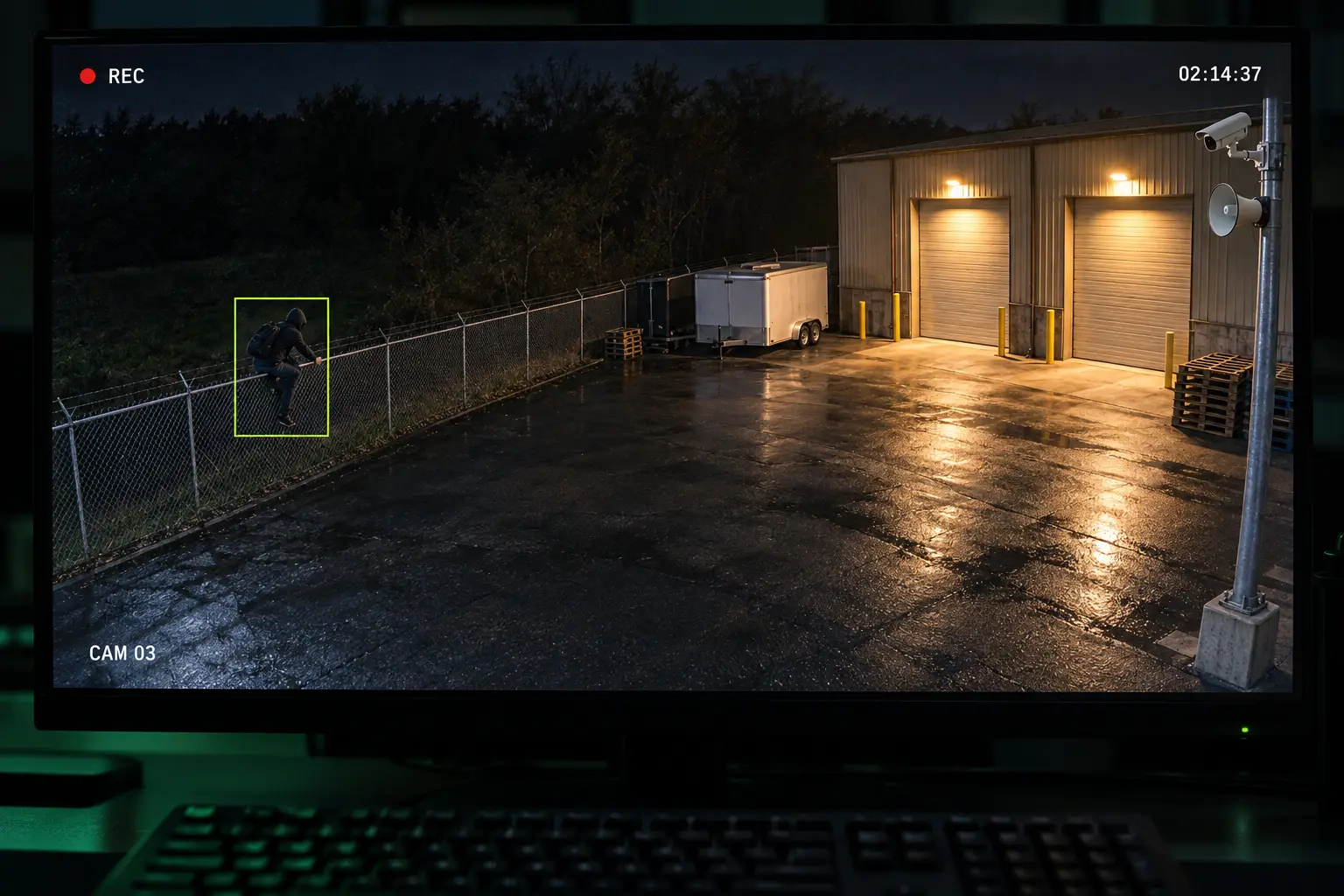
Here is how monitoring works on your site. Detection flags movement at your gate or fence after hours, someone hanging around your lot, someone where they shouldn’t be. A trained agent, a real person, is live on your feed within seconds. Our average response time is under 30 seconds, so a voice can reach them while they’re still at the fence. We notify authorities when required, so you’re not the one calling at 2 a.m. And the morning brings a report, not a surprise.
An alarm vs. a person who saw them
Austin: 95% of police dispatches to burglar alarms were false alarms or not a police matter.
Source: City of Austin, Council Resolution 25-0232, March 2025, citing an Austin Police Department analysis of 114,403 alarm dispatches over three years, September 2020.
Seattle: police do not respond to an alarm on a sensor alone. They need evidence, such as audio or video.
Source: Seattle Municipal Code 6.10 and Seattle Police Department alarm page. In effect since 1 October 2024.
Toronto: 97% of alarm events are false, and police want alarms verified first.
Source: Toronto Police Service.
What it means for you: most alarms are false, and in cities like Seattle and Toronto, police now want alarms verified first. A Blinkless agent who has seen someone on your camera can give exactly that.
- 3,000+ break-ins prevented. We have done this thousands of times. Your yard is not where we learn the job.
- Under 30 seconds, on average. That is our average response time. Compare it with the 4 a.m. alert you slept through.
- Up to 70% lower cost than on-site guards. A person on your cameras after hours, for far less than a guard. Weigh it against one stolen skid steer, not against your camera bill.
Blinkless’s own figures. Response time is an average; cost is compared with traditional on-site guards.
“As a growing construction company managing multiple job sites, we struggled to find a practical way to keep eyes on everything after hours. Traditional security guards couldn’t be everywhere at once, and the costs were adding up. We turned to Blinkless to bridge that gap, and their remote monitoring system has made a real difference. With full visibility across all sites, we now prevent unauthorized access, vandalism, and material theft. Blinkless gives us reliable data, immediate alerts, and the confidence that our sites are being looked after.”
Gefen Construction and Development
“A video that records onto a card for later viewing does little good once all the tools are gone and so are the burglars.”
Demolition contractor
You already paid for cameras. A camera nobody watches only records. In most cases, we can monitor the cameras you already have, so the money you spent starts working at 2 a.m. We check yours in the free assessment, remotely, from satellite imagery and your existing cameras. No site visit. You find out whether your cameras can be monitored before you sign anything.
| Option | What it does at 2 a.m. | The catch (for Blinkless: what you get) | Cost |
|---|---|---|---|
| Blinkless | A trained agent is live on your cameras within seconds and warns intruders off over your speakers, in a live voice. | Average response under 30 seconds. Authorities notified when required. Alerts with footage, then a report. Your existing cameras, in most cases. | Up to 70% less than on-site guards |
| Recording only | Records someone climbing your fence. | You find out after the damage is done. | Not stated |
| Alerts on your own phone | Buzzes your phone. | You are the night guard. It only helps if you’re awake, see it and can act. By the time you get to the site, they’re gone. | Not stated |
| A guard on site | A person is physically there. | One guard covers one spot. | Round the clock, it can cost $15k+ a month |
| A stronger fence | Slows people down. | Nobody sees who is climbing it. | Not stated |
Even at the median guard wage, $18.28 an hour, one post around the clock is about $13,300 a month in wages alone.
Source: U.S. Bureau of Labor Statistics, May 2025.
What it means for you: one guard on one post around the clock is a five-figure monthly bill before anyone adds a margin.
Already have a guard? We can support on-site guards too, with eyes on the cameras the guard can’t cover.
Comparing monitoring companies? Ask three things. Is a person watching your cameras live? Do they speak to the intruder? How fast? Our answers: yes, a trained agent; yes, over your speakers; under 30 seconds on average. “24/7 monitoring” should mean a person, not just cameras that stay on.
You don’t have to take our word for any of this. Before the standard term starts, you get a 60-day pilot on your site, with your cameras. After the pilot, the standard term is 12 months. You know that up front, in plain words. Run more than one site? Several locations go under one billing address, in one contract. One contract to read. One bill to pay.
- City of Austin, Council Resolution File 25-0232, March 2025.
- Federal Bureau of Investigation, Crime in the United States 2019, Table 23 and Burglary (2019 data).
- City of Seattle, Seattle Municipal Code 6.10, and Seattle Police Department alarm page (in effect since 1 October 2024).
- Toronto Police Service.
- U.S. Bureau of Labor Statistics, Occupational Employment and Wage Statistics, Security Guards (33-9032), May 2025.
- Blinkless, own figures: break-ins prevented, average response time, cost compared with traditional on-site guards, and the New York example.
We assess your site remotely, from satellite imagery and the cameras already up. Nobody needs to come out. Then you get a written security plan. It’s yours to keep, whether you hire Blinkless or not.
- Your site. Tell us where it is and what you’re protecting.
- The assessment. We study it from satellite imagery and your existing cameras, and check whether they can be monitored.
- Your plan. In writing: what needs monitoring, during which hours, how intruders would be handled and who gets alerted.
If you want to go ahead, next comes the 60-day pilot, then our standard 12-month term, with several locations in one contract if you need it.
3,000+ break-ins prevented. Average response under 30 seconds. Up to 70% less than on-site guards. Sites across the USA and Canada. Blinkless’s own figures.