
Maybe you know the one who got in. A car rides close behind a resident’s, under the arm before it drops. A name and an apartment number at a desk, and up he goes. A standing “let them in”, and a visitor comes straight into the community without anyone knowing.
Each time, the gate opened. Nobody asked who they were.
You may be thinking: what we have covers it. The code, the call box, the app. Residents let their own guests in.
That’s fair. It costs little, and for residents it works. A community’s board put the guest side in writing.
Re: Immediate Security Update · a property owners’ association board · 23 March 2025
“So, if a visitor comes up to the gate and there is a blanket opening allowed, the visitor can come straight into the community without anyone knowing.”
The same letter set the new rule: “for any visitor not on your friends & family or vendors list, the security staff must call that property owner”. And: “If the security staff cannot reach the property owner, that visitor or vendor will be turned away.”
- A visitor rings at the gate.
- The guard at the gate calls the owner.
- In, or turned away.
For your board, that means the rule was the easy part: one board wrote it in a paragraph. What makes it work is a person at the gate who applies it at every ring. That community’s guard stood at the gate. Virtual Concierge does the same job from our monitoring station, on the rules your board writes.
Source: A property owners’ association board, “Re: Immediate Security Update”, 23 March 2025.
An industry example shows the same press of nine at a 370-home Florida community. Before its change, “guests used a call-box to dial a resident. The resident would hit the number nine on their phone to open the gate, or a four-digit code could be used to enter.” The community later chose a service in which “Live guards, located at the remote Central Station, speak with and verify guests arriving at the entrance”.
For you, that means a community of 370 homes chose to have a live guard answer its gate from off site.
Source: Another provider’s published client story (an industry example), undated.
“But an attendant solves everything because then there’s someone to let them in without them getting the code, while ensuring they only enter when invited.”
So what lets your guests in today: a number, or a person who asks?
And when nobody asks, your board hears about it the morning after.
The morning after lands on the board. A homeowners’ site, February 2026: “Our high-resolution cameras at the ... gate captured a tailgater plowing through the security arm.” It was the second damaged gate in two weeks.
For your board, that means clear footage still leaves volunteers “chasing evidence, vendors, and insurers”. The site’s own conclusion: “Live security presence works.”
Source: A homeowners’ site, 17 February 2026.
So your board prices a person.
Picture the budget meeting. The gatehouse line is on the page, and someone has to say it out loud.
You may be thinking: the only real answer is a person in the gatehouse. We can’t afford one, and our residents won’t let us cut one.
That’s fair. When officials proposed fewer gate attendants at The Villages, Florida, in 2025, the deputy district manager warned: “You can enhance the level of service, but you cannot reduce it”. Residents “bought their homes with the concept of the gates, including the manned gates”. The proposal had said: “The eyes of a camera will take over for a person.”
For your board, that means a camera in the person’s place reads as a cut. A person who still answers, from off site, reads as the same service, enhanced.
Source: Villages-News.com, 9 July 2025 and 8 October 2025.
The cost is real too. A seller’s guide for boards: “For a lot of communities, the guardhouse is the single biggest security expense in the budget. It is also the one nobody wants to be the first to question.” One gate post is “roughly four and a half full-time positions once you account for shifts, weekends, vacation and call-outs.”
For your board, that means one gate is about four and a half people on the payroll before anyone names a wage.
Source: A seller’s guide for boards, 11 August 2026.
And the room is never only about money. At a California district in December 2025, outsourcing the gatehouse would have eliminated “10 CSD positions at the gatehouse”. Opponents said those employees “offer the first impression many people have of the community”, and the board reversed course after the contractor’s revised bid came in “with a total cost of 50% more than the original”. Elsewhere, a residents’ newsletter argued against “$132,000+ on a gate that 44 percent of those surveyed oppose”, an unmanned gate, reported that “Nearly 140 owners attended last month’s Board meeting”, and signed off: “Keep our gate human.”
For your board, that means residents aren’t objecting to technology. They want the person, and the welcome, kept.
Sources: Tehachapi News, 12 December 2025; a residents’ newsletter, 7 March 2026.
The Villages had already proposed a way through. In August 2024, its Community Watch announced it “will eliminate late-night attendants at gates in The Villages”: “a decrease of 30 hours per day across those five gate locations, totaling 10,950 hours annually”. Those gates “average only five vehicles per hour between midnight and 6 a.m.” The community’s own phrase for the change: “The gates may not be manned overnight, but they will be monitored”, with “personnel for virtual monitoring”. And: “Even with this addition, the proposed changes would result in overall net savings”. Community Watch “expects to save $1.9 million over a five-year period.”
For your board, that means a community chose to keep a person on its gates, answering from off site, and expects to come out ahead. The answerers are The Villages’ own staff; the hours and the figures are The Villages’ own. A person who answers from off site is the move Virtual Concierge offers you.
Source: Villages-News.com, “Community Watch to eliminate late-night attendants at gates”, 12 August 2024.
So does your board have to choose between the person and the budget?
Virtual Concierge keeps the person and moves the answer off site. It enhances the level of service your residents bought into and never reduces it: a trained guard still answers your gate, without the cost of on-site staff.
Here’s how a ring is answered.
You may know it as a virtual doorman. In our own words: “Think of it as having a person by the entrance ... based on the protocol he lets them in, or not. So we do the same thing, just remotely.”
- The bell. Where your gate or front door has no bell, we install one and set it up.
- The ring. A visitor rings, and the ring comes directly to our monitoring station.
- A live answer. A trained Blinkless guard answers: a live voice, not a recording. For example: “Good afternoon, Blinkless security. How may I help you?”
- Two questions. The guard asks who they are and whom they are there to see.
- Your protocol. Your building sets the protocol: who gets in and how guests are checked. The guard applies it, at every ring.
- In, or kept shut. On your protocol, we unlock the door or open the gate and let them in, or we keep it shut.
At a community gate, our team speaks with visitors, verifies entry approval and opens the gate.
Picture your call box again. This time the ring comes to us. A trained guard greets your visitor, asks the two questions and follows your protocol. The gate opens, or it stays shut, and nobody upstairs makes your board’s decision for it.
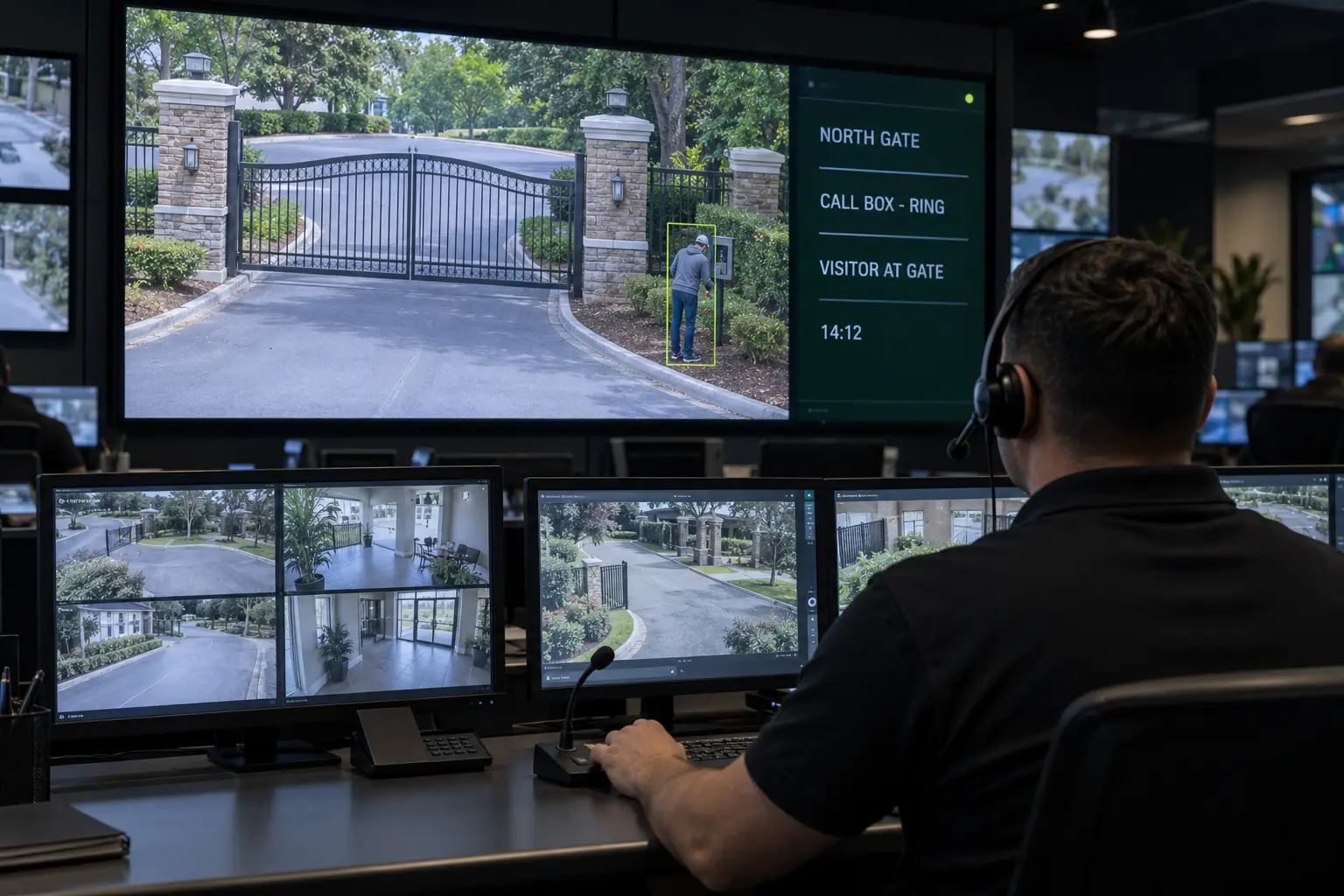
The next fair question: will a guard off site keep your rules?
Maybe the doubt is this: a remote guard can’t hold to our rules, and it’s for big, rich communities.
It’s a fair doubt. Your rules are your board’s own, and your budget is real. Look back at the board’s letter: the rule was the board’s, and the person’s job was to apply it.
The doorman was there, in the building. The call-up was skipped. The uniform is not the protection. The rule, kept at every ring, is.
“He told the doorman my full name and apartment number, said he wanted to come up, and the doorman let him up (they’re supposed to call up and confirm first, but didn’t this time).”
A Tampa community district’s chair said it in 2022: “If we couldn’t secure the gate, and we couldn’t check identifications, then why were we paying $77,000 a year for someone that couldn’t do anything but flip a switch?” The district’s later plan: “a state-of-the-art virtual guard system” at its two entrance kiosks.
For your board, that means a person at the gate is worth what your rules let them decide. Your rules make the person valuable, on site or off.
And size? You may have heard that attendant-controlled gates are too expensive for small neighborhoods of 100-200 single-family homes. Virtual Concierge is for any and every building where people ring to get in: residential buildings and complexes, gated communities, HOAs, commercial buildings, hotels and motels, across the USA and Canada. It gives you an extra layer of access control without increasing payroll.
So whose rules does the guard keep at your gate, and how big do you need to be?
Add the lobby and the packages
And the lobby and the packages? That’s even more of what you came for. Virtual Concierge answers your door. Blinkless remote security monitoring keeps an eye on the lobby and checks the packages, so a box that walks out of the lobby with the wrong neighbor is in view too. It’s priced separately, so a building can add it to Virtual Concierge, or take either one.
Here’s how Virtual Concierge sits next to what you have today.
| Question | Blinkless Virtual Concierge | A staffed gatehouse or desk | A call box or intercom that rings residents | Codes and fobs | A camera-only gate |
|---|---|---|---|---|---|
| When someone rings | A trained guard answers live and asks who they are and whom they’re there to see | A person on site greets them | A resident’s phone rings | No ring: whoever has the code comes in | The camera records the arrival |
| What you get | A person, not a recording, on your protocol at every ring | A person on site: “the first impression many people have of the community” | Cheap, and residents let their own guests in | Cheap entry for residents | Clear footage of what happened |
| The catch | Even more: add lobby and package monitoring | One post is about 4.5 full-time positions, and a call-up can still be skipped | Whoever answers decides, and one press of nine opens the gate | A code opens the gate for whoever has it, and codes travel | Residents can read it as a cut: “The eyes of a camera will take over for a person.” |
| Cost | Talk numbers in your free consultation | About $13,700 a month (concierge median) or $13,300 (security guard median) in wages alone for one post staffed every hour of the year; about 4.5 full-time positions per post (a seller’s guide) | Low | Low | Varies with the equipment |
Sources: US Bureau of Labor Statistics, OEWS, May 2025 medians: concierges $18.73 an hour, security guards $18.28 an hour; our arithmetic: wage × 8,760 hours ÷ 12. A seller’s guide for boards, 11 August 2026. Tehachapi News, 12 December 2025. Villages-News.com, 2025.
Sources
- A property owners’ association board’s letter, “Re: Immediate Security Update”, 23 March 2025.
- Villages-News.com, “Community Watch to eliminate late-night attendants at gates”, 12 August 2024.
- Villages-News.com, “Official proposes ‘paradigm shift’ in approach to gates”, 9 July 2025, and “AAC ready to join PWAC in exploring major change to entrance gates”, 8 October 2025.
- A residents’ newsletter, 7 March 2026.
- A homeowners’ site, 17 February 2026.
- Another provider’s published client story (an industry example), undated.
- A seller’s guide for boards, 11 August 2026.
- Neighborhood News (Tampa), “A Gated Community At Last?”, 9 April 2022.
- Tehachapi News, on a California district’s gatehouse, 12 December 2025.
- US Bureau of Labor Statistics, Occupational Employment and Wage Statistics (OEWS), May 2025: Concierges and Security guards.
- How a ring is answered: Blinkless’s own description.
Tell us about your gate or front door. In a free security consultation, we talk through how visitors get in today and how a trained Blinkless guard would answer the ring there.
Your board keeps writing the rules. We answer the ring by them.
- You send the form.
- We talk through your entrance: the gate or door, who rings, who you let in, and whether there’s a bell.
- You hear how a ring would be answered there, by your rules.