
You know the night. One code shows in the gate log. Two cars come through.
The second one rides the tenant’s bumper so close the gate slides shut on both. Or a code that shouldn’t work opens it anyway. You sit up with the app open until the gate closes.
The thought that lets you lie back down: my gate, my codes, my disc locks and my cameras cover it.
That’s fair. They record, and they slow people down. But think about what actually sends someone back to their car.
“Hopefully, if I greet someone who’s up to no good, they’ll leave knowing they were noticed.”
What it means for you: The point of the greeting is that they know they were noticed. On an unstaffed site at night, nobody greets the second car.
Source: Inside Self Storage, “Modern Crime Prevention Strategies for Self-Storage Operators”, a facility manager, June 2021
So what did your gate do about that second car? It logged it. Your equipment records them. Nobody notices them.
This time, detection flags the second car and a trained agent is alerted immediately. Within seconds the agent is live on your cameras, and a live voice over your speakers orders the driver to leave.
Start with a free remote assessment, built from satellite imagery and your existing cameras, with no site visit.
The gate is the night you see coming. The far row is the one you don’t.
Picture it. The phone buzzes on the nightstand. Motion, far row.
You open the clip. A figure at a unit door. A spray of orange sparks from a grinder.
You’re an hour away. Maybe two. Your keys are already in your hand.
“we saw them pull into the site [...] and dip all within 4 minutes. We got there about 2 minutes later but unfortunately we didn’t get them.”
Somewhere between the bed and the car, the other thought arrives: nothing stops them at night, and the cops won’t come for a cut lock.
That’s fair, and it comes from inside the trade:
“Some police departments take a hands-off approach to minor crimes, and getting an officer to the facility can be a challenge.”
What it means for you: You’re not imagining it. Waiting on a patrol car for a cut lock is a hard plan to run a facility on.
Source: Inside Self Storage, “Strengthening Your Self-Storage Security Program to Fight Crime”, a regional manager with 22+ years in the industry, May 2026
The same regional manager names what moves the odds:
“Quick reporting increases the likelihood that police can respond before the suspect leaves the area. It’s important that you never engage with criminals directly.”
What it means for you: Speed at the site improves the odds. And the trade’s own rule keeps you out of it: you never engage them yourself.
Source: Inside Self Storage, “Strengthening Your Self-Storage Security Program to Fight Crime”, May 2026
So put the keys down and say it the way it is: you can’t control how the police respond. You can control how fast someone acts at the site.
This time, detection flags the figure at the unit door and a trained agent is alerted immediately. Within seconds the agent is live on your cameras, and a live voice over your speakers orders the intruder to leave. We notify authorities when required. Your keys stay on the hook.
That’s the night someone acts. The nights nobody does, you meet in the morning.
“Cameras are fine, after the fact.”
You know the call. A tenant, early, voice tight. “My lock’s gone.”
You walk the row with the gate log open on your phone. One unit. The next. Two more. Cut shackles on the concrete.
Then one door with a shiny, cheap new lock on it. A unit that was broken into, dressed up so nobody looks twice.
This isn’t bad luck. It’s the night the trade plans for:
“The most common crime that occurs in our industry is burglary ... This is typically done by cutting locks or forcing open doors.”
What it means for you: Burglary, typically by cutting locks, is the industry’s most common crime. Your far row is the night to plan for.
Source: Inside Self Storage, “Strengthening Your Self-Storage Security Program to Fight Crime”, May 2026
So you work the checklist. Overlock the unit. Check for other break-ins, and the fence for cuts. Call the authorities. Call the affected tenants: “Often, they’ll need to file a police report separate from the one you create.” Then review the camera footage and the gate logs.
What it means for you: Each step starts after they’ve left.
Source: Inside Self Storage, “Strengthening Your Self-Storage Security Program to Fight Crime”, May 2026
Then the Storage Shield tenant protection plan’s claim list asks for this:
“A screenshot of the security footage at the time the lock was cut is also necessary.”
What it means for you: The plan asks for one specific moment. The camera saw the lock being cut. Who was looking?
This time, someone is looking when the grinder starts. The agent warns the intruder off over your speakers, and the alert comes to you with footage. Reports and footage are there on demand, so your morning starts with a record instead of a search.
A person on the cameras sounds like something for operators with a staffed office. Unmanned operators have been doing it for years.
You run unmanned on purpose. Kiosk rentals, a coded gate, a lean payroll. Two facilities, maybe, and no office.
So a person on the cameras sounds like it belongs to the big operator. Fair: building a call center to cover your sites makes no sense.
Here’s how a four-facility operator, unmanned since 2015, does it:
“The facility also makes liberal use of video cameras backed up by well-trained agents at the company’s 24/7 call center.”
What it means for you: Unmanned and a person on the cameras go together. The only part you’d rather not build is the call center.
Source: Inside Self Storage, “Advancements in Unattended Self-Storage Operation”, November 2017
So you can say it plainly: unmanned operators already put people on their cameras. You can too, without building the call center.
That’s what Blinkless remote video monitoring does for self storage after hours. In most cases it runs on the cameras you already have; we integrate existing cameras or install new ones.
- We detect. Loitering, unauthorized access, trespassing, after-hours movement, suspicious movement. For you: The far row gets flagged, in most cases on the cameras you already have.
- A trained agent is alerted immediately. When a potential threat is detected, a trained agent is alerted immediately. Within seconds, the agent is live on your video monitoring feed. Average response time is under 30 seconds. For you: An agent is live on your cameras within seconds, while you’re still an hour away.
- The agent checks first. AI filters false alarms, and a live operator verifies what’s on camera. For you: A tenant who lost track of time gets a person looking first, not a voice treating them like a break-in.
- A live voice over your speakers. The agent warns intruders off and orders them to leave. For you: They hear they were noticed while they’re still on site.
- We notify authorities when required. For you: When the authorities are called, the call comes from someone already looking, and you never engage anyone yourself.
- Alerts with footage, reports on demand. Alerts arrive with footage. Reports and footage are available on demand, with documentation for compliance and audits. For you: The morning starts with the record, not the search.
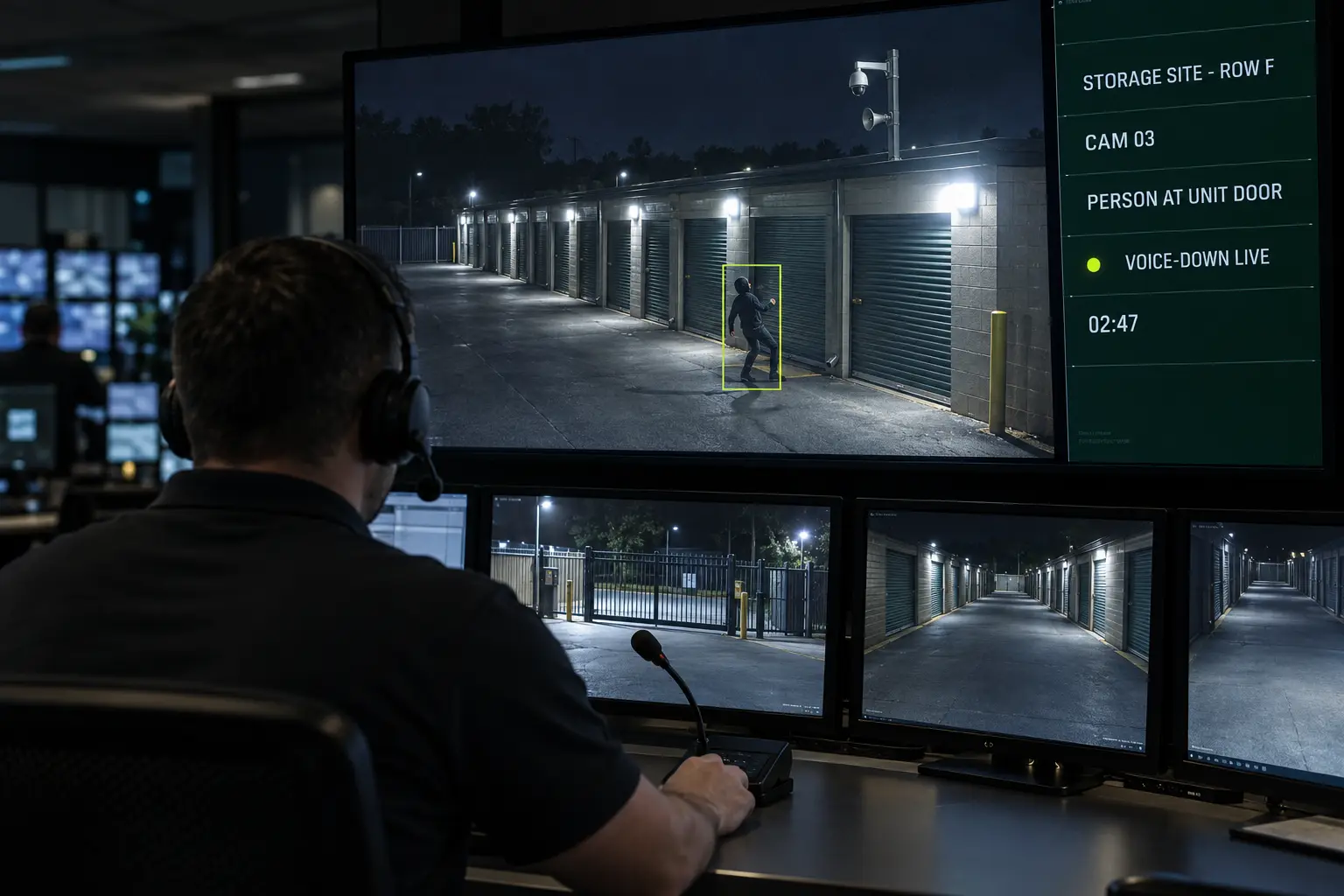
Here’s what that looks like on a clock.
Here’s a real night from one of our customers, a residential property in New York.
- 1:35 a.m. Attempted break-in detected.
- 1:36 a.m. A live security agent is alerted by detection and is live on camera, assessing the situation.
- 1:37 a.m. A verbal warning is issued over the speakers.
- 1:37 a.m. The intruder leaves.
- 1:38 a.m. The client receives alerts, footage and a report.
From detection to resolution in under three minutes, without police dispatch or property damage.
Put that clock next to the four minutes on your far row.
- 3,000+ break-ins prevented across the properties we serve. For you: The same trained agents and the same steps, on your cameras.
- Average response under 30 seconds. For you: The agent is live on your cameras before you’d have found your keys.
- Up to 70% lower cost than traditional on-site guards. For you: A person on your cameras after hours, without the cost of one on site.
Several sites, nobody there after hours. That’s your setup too, and it’s the one this customer brought to us:
“As a growing construction company managing multiple job sites, we struggled to find a practical way to keep eyes on everything after hours. Traditional security guards couldn’t be everywhere at once, and the costs were adding up. We turned to Blinkless to bridge that gap, and their remote monitoring system has made a real difference. With full visibility across all sites, we now prevent unauthorized access, vandalism, and material theft. Blinkless gives us reliable data, immediate alerts, and the confidence that our sites are being looked after.”
| Question | Blinkless | Cameras reviewed in the morning | You or your manager on call | Unit alarms and a central station | A resident manager or a guard |
|---|---|---|---|---|---|
| What happens after hours | A trained agent is alerted immediately, goes live on your cameras within seconds (average response under 30 seconds) and warns intruders off over your speakers. | The cameras record. You see it at the morning review. | The alert reaches your phone, wherever you are. | A unit alarm signals that a door opened, and the central station follows its response process. | A person on site can respond in person. |
| The real strength, and its but | What you get: a person on your cameras after hours, a live voice at the site, alerts with footage and reports on demand. | A record of the night. But it’s found after they’ve left. | Nobody knows your site and tenants better. But it depends on you being awake and near enough, every night, at every facility. | A signal tied to the unit. But it’s an alarm response, not a live voice from your cameras. | A real person at the property. But coverage depends on the staffing schedule, and it’s payroll at every facility. |
| Cost | Up to 70% lower cost than traditional on-site guards | Not stated | Not stated | Not stated | “Expensive? having a manager at 70+k/year is expensive.” (Self-storage operator) |
The fastest way to see which column fits your facility is a free look at it.
- Inside Self Storage, “Strengthening Your Self-Storage Security Program to Fight Crime”, May 2026
- Inside Self Storage, “Modern Crime Prevention Strategies for Self-Storage Operators”, June 2021
- Inside Self Storage, “Advancements in Unattended Self-Storage Operation”, November 2017
- StorSuite, Storage Shield claim requirements
- Blinkless figures, the New York night and the customer testimonial: our own
- Buyer quotes: self-storage operators in their own words, trimmed; role only
- Free remote assessment. Built from satellite imagery and your existing cameras, with no site visit. For you: Nobody to meet at the gate, no day lost on the road.
- A written security plan. What needs monitoring, during which hours, how intruders and break-in attempts would be handled, and who gets alerted. Yours to keep whether you hire Blinkless or not. For you: A clear picture of your after-hours gaps, on paper, either way.
- A 60-day pilot on your own facility. For you: You see it work on your rows, your gate and your nights.
- A 12-month standard term after that. For you: A clear term to plan and budget around.
- Several facilities in one contract. One billing address. For you: Two sites an hour apart become one agreement.
- USA and Canada. For you: Coverage for facilities across the USA and Canada.