
Your cameras are up. The app is on your phone. Motion alerts are on. It’s a smart way to cover a site, and when you catch an alert in time, you can call the police while they’re still there.
Look at what the gear promises. One national rental fleet sells its camera tower as “Camera, Recording, 4G Cellular Plan,” to “Monitor and Control from any Desktop, Laptop, or Smartphone.” One cellular jobsite camera prices its plans by alerts, per camera: “$10 /mo ... includes 500 alerts,” “$15 /mo ... Offers 1,000 alerts,” “$20 /mo ... Provides unlimited alerts.” Another seller puts it plainly: “Just mount and monitor from your phone.”
The plan counts alerts by the hundred, and each one lands on one phone: yours. As the equipment is built, the watching is your job.
Source: a national camera-tower rental fleet’s flyer; two jobsite camera sellers’ plan and product pages (2026).
So picture the nights of nothing.
1:40 a.m. The phone buzzes on the nightstand. Wind? Headlights? A cat on the fence line? You check. Nothing. 2:15, again. Whoever’s next to you rolls over and sighs. By 2:50, maybe you’ve turned the sensitivity way down, or muted the site that pings the most. Now the one alert that matters can slip past while you sleep.
And maybe it’s more than one site: the yard, the job, the storage lot, the store across town. All on one phone.
“I have two shops on a pretty busy street and I have to have my phone next to me with the ringer on in case they actually do get broken into”
Is your site covered, or is it covered when you’re awake?
This time, 1:40 a.m. is ours. AI filters false alarms, and live operators verify events. When a potential threat is detected, a trained agent is alerted and goes live on your feed within seconds, at each site we cover for you. Your phone stays on the nightstand, with the alerts and footage there when you want them.
Your cameras were never the gap. The gap was asking one person to be awake for all of them.
And the alert you muted at 2:50? In Bend, Oregon, alarm calls rarely ended in a police report.
10,274 alarm calls
76 police reports
26 for burglaries
In Bend, “many of the recent calls were generated by activated motion detectors at empty second homes and unoccupied businesses. Sometimes, a pet is to blame. Sometimes, it’s an unlocked door and a gust of wind.” In 2022, Bend Police said they would stop automatically responding to some alarm calls, those from home security systems; alarms at businesses are still answered automatically. In Bend’s numbers, an alarm call almost never meant a burglary.
Source: The Bulletin (Bend, Oregon), “Bend Police will stop automatically responding to some alarm calls,” 15 June 2022.
Which brings you back to 3:07, and the next ten minutes.
Say you catch it.
3:09 a.m. Is that a person? It is. You call the police from bed, whispering, and describe a grainy figure by the fence.
3:14. You think about driving over: the cold car, the dark roads. They may well be gone before you get there. And a dark lot at 3 a.m. is a drive you’d never ask an employee to make. So it’s you, or it’s no one.
You may believe that’s just how it goes: cameras record, and the police won’t come for a motion alert. That’s a fair read in some cities, for a call from an alarm company. Now look at what the police are being told. In Los Angeles, the department manual sorts the same night two ways.
| In Los Angeles: Code Thirty | In Los Angeles: Code Thirty Victor |
|---|---|
| A silent burglar alarm reported by an alarm company. | “A visual verification alarm has been activated,” with “the display of photographs depicting an intruder.” |
| “This call is broadcast for general information ... Units in the vicinity should respond to the call but remain available for calls ...” | “A unit shall be dispatched to respond to the call immediately.” |
In Los Angeles, an unauthorized entry or attempted entry also counts as verified when the alarm system user, a person at or near the scene, a private guard responder or an alarm company operator confirms it “by remote visual inspection of the premises.”
So in Los Angeles, a silent alarm reported by an alarm company goes out as general information, and units nearby should still respond. When the alarm company sends photographs of an intruder from a visual verification alarm, a unit is sent at once. There, what the police are told decides how the call goes out.
Source: Los Angeles Police Department, Department Manual, Volume 4, 4/120.40 and 4/203.60 (file of 25 January 2023).
So is it the hour that’s against you, or what the police are told?
Or you sleep through it. Maybe you know that morning too. 6:40 a.m., the walk up to the gate. The cut fence. The empty spot where the machine was. The footage is clear. You get a case number.
Traditional security cameras only record what happens. You find out after the damage is done.
“Cameras don’t do much. Neither do police reports.”
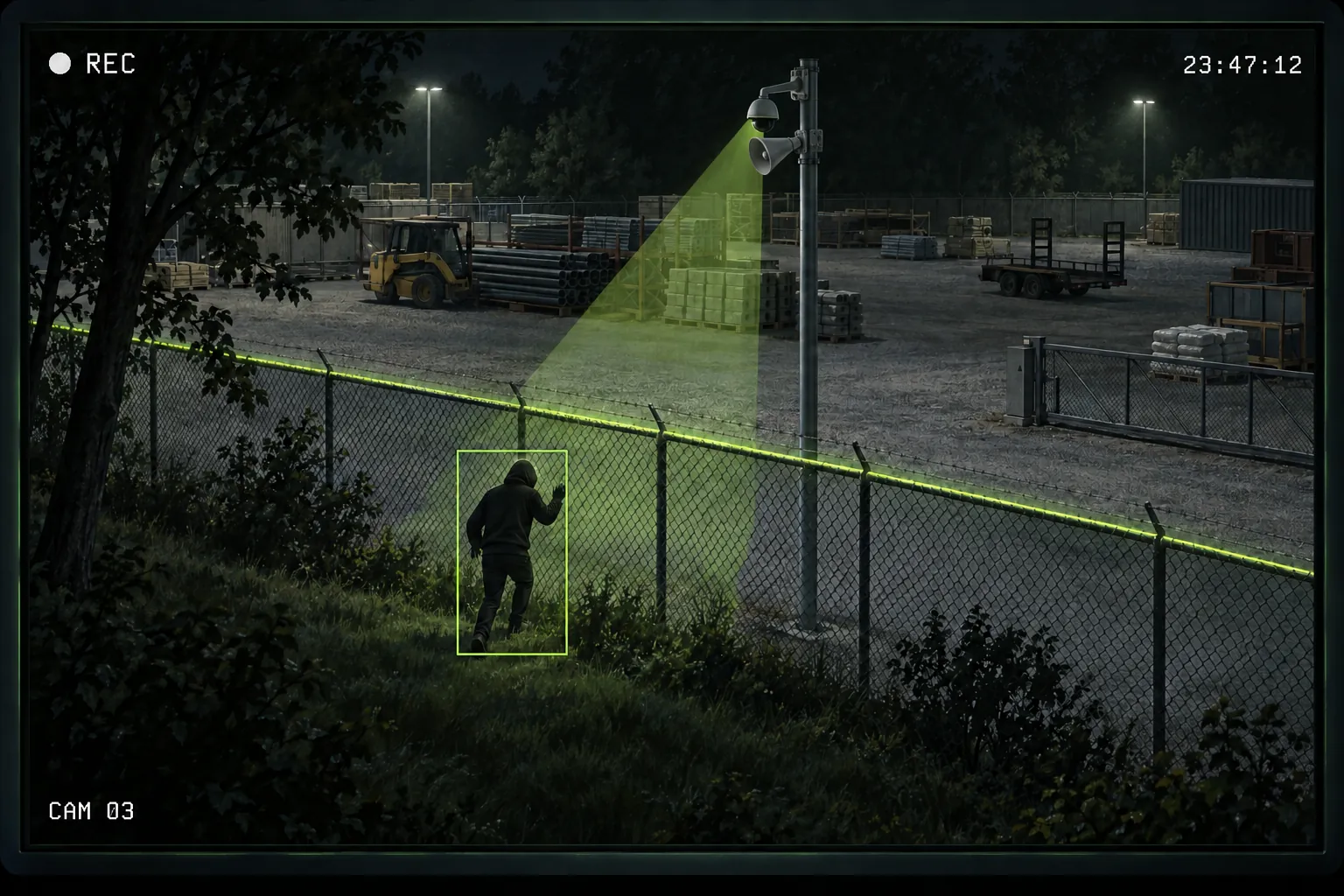
This time, 3:09 a.m. goes differently. Detection flags activity at the fence. A trained agent is live on your feed within seconds and warns the intruder off with a live voice over your speakers. We notify authorities when required. In the morning, the alert with footage and a report are waiting for you.
So the question isn’t whether you can see them. It’s whether anyone tells them to leave.
Blinkless remote video surveillance runs 24/7 and does its hardest work after hours. Detection technology flags loitering, unauthorized access, trespassing and after-hours movement. AI filters false alarms, and live operators verify events.
Detection flags activity on your cameras.
A trained agent is alerted and goes live within seconds.
A live voice over your speakers warns intruders off.
We notify authorities when required.
You get alerts with footage, and a report.
The voice is a live one, not a recording. In most cases, it all runs on the cameras you already have, and where you need more, we integrate existing cameras or install new ones. Here’s more on how remote video monitoring works.
Our own example, from a residential property in New York. The same steps run on a yard’s cameras.
- 1:35 a.m. Attempted break-in detected.
- 1:36 An agent is alerted and goes live on camera.
- 1:37 A verbal warning over the speakers. The intruder leaves.
- 1:38 The client receives alerts, footage and an incident report.
Set that next to your 3:09 call from bed and your 3:14 drive. By 1:38, the client had footage and a report in hand.
Source: Blinkless’s own example.
3,000+ break-ins prevented, by our own count. Each one stopped before it escalated, not found on the footage the next morning.
Average response time under 30 seconds, from trained security professionals, while your phone stays on the nightstand.
Up to 70% lower cost than traditional on-site guards. That puts a trained agent within reach of a yard, a job or a few stores. We can also support the on-site guards you keep.
Source: Blinkless’s own figures.
“As a growing construction company managing multiple job sites, we struggled to find a practical way to keep eyes on everything after hours. Traditional security guards couldn’t be everywhere at once, and the costs were adding up. We turned to Blinkless to bridge that gap, and their remote monitoring system has made a real difference. With full visibility across all sites, we now prevent unauthorized access, vandalism, and material theft. Blinkless gives us reliable data, immediate alerts, and the confidence that our sites are being looked after.”
| Option | What happens at 3 a.m. | The catch (Blinkless: what you get) | Cost |
|---|---|---|---|
| Blinkless | Detection flags activity. An agent is live within seconds and warns intruders off. | Alerts with footage, a report, authorities notified when required. At each site we cover, overnight and after hours. | Up to 70% lower cost than traditional on-site guards. |
| Watching it yourself | You see the alert if you’re awake, and decide alone. | You know your site. But it rests on you, every night, at every site. | What you already pay. |
| Alerts down or off | A quiet night for you. | You sleep. But the alert that matters can slip past. | What you already pay. |
| Recording only | The camera records the fence. | Clear footage for the report. But you find out after the damage is done. | What you already pay. |
| A guard on site | A person on site, at one post. | Someone there in person. But you pay for every hour, at every post. | About $13,300 a month in wages alone for one 24/7 post. |
| An alarm central station | The station gets the signal. | Someone answers the signal. | A monthly fee; it varies by provider. |
An alarm central station
In Lubbock, a 2025 proposal would have stations try the owner twice before reporting to police. If no one is reached, police still respond.
But in Seattle, “SPD does not respond to calls from alarm companies based on sensor or motion activations alone” (from 1 October 2024). It does respond to calls “with evidence of a crime in-progress,” such as “audio, video, panic alarms or eyewitness evidence that a person is illegally entering or attempting to enter” a property, and to “all robbery, panic, and duress alarms.”
Sources: Seattle Police Department, “Monitored Alarms” (City of Seattle: from 1 October 2024). Lubbock Lights, August 2025 (proposed ordinance, Lubbock only). US Bureau of Labor Statistics, OEWS, Security Guards, May 2025: median $18.28 an hour; $18.28 x 8,760 hours / 12 is our arithmetic.
You may think a live agent on your cameras means new cameras, a site visit and a guard’s price. Something for big operators. That’s a fair read of how security has been sold.
Here’s an industry example from another provider. In 2018, a US building-supply chain with 300+ sites had “a significant number of burglaries” at its fenced yards and “extremely high false alarm rates.” Its new provider enrolled sites by “adding audio to the current surveillance system.” “300 retail site locations were being monitored within 20 business days.” In the first year, more than 100 break-ins were detected (the case says 100+), and 17 led to apprehensions. “False alarm rates were reduced by 89% within the 20-day transitionary period.”
In that example, the chain kept its cameras, added audio and was live in 20 business days. People looking live meant arrests, not just footage.
Source: Security Executive Council case study, “Company Achieves Superior Risk Mitigation Performance and ROI by Transforming Security Services with Remote Audio/Video,” client authenticated March 2022. An industry example from another provider.
Monitoring stations work this way broadly. One US station takes “hundreds of video products.” Another lists “500+ camera brands, VMS platforms.” A wholesale group describes “a three-day test of the cameras and the analytics before we take it live.” Watching the cameras a site already has is normal practice, and a short test is how it’s done.
Source: US monitoring stations’ service pages; a wholesale monitoring group in the trade press, 2022.
With Blinkless, it starts on what you already have. In most cases, we work with your existing cameras. We assess your site remotely, from satellite imagery and your cameras. Then, in most cases, a 60-day pilot on your compatible existing cameras. And it costs up to 70% less than traditional on-site guards.
Big operators only? Or does it run on what you have, with the pilot as the test?
In most cases, after your assessment comes a 60-day trial pilot on your compatible existing cameras. You see the alerts, the footage and the reports from your own nights.
The standard term is 12 months. Several locations under one billing address go in one contract, with sites across the USA and Canada.
- Los Angeles Police Department, Department Manual, Volume 4, 4/120.40 and 4/203.60, file of 25 January 2023.
- The Bulletin (Bend, Oregon), “Bend Police will stop automatically responding to some alarm calls,” 15 June 2022.
- Camera sellers: a national camera-tower rental fleet’s flyer; a cellular jobsite camera’s plan page and app description; a second jobsite camera seller’s product page (2026).
- Security Executive Council, “Company Achieves Superior Risk Mitigation Performance and ROI by Transforming Security Services with Remote Audio/Video,” client authenticated March 2022 (an industry example from another provider).
- Monitoring stations: a US station’s product list; a station’s service page; a wholesale monitoring group in the trade press, 2022.
- Lubbock Lights, August 2025 (proposed ordinance).
- Seattle Police Department, “Monitored Alarms” (City of Seattle: from 1 October 2024).
- US Bureau of Labor Statistics, OEWS, Security Guards, May 2025.
- Blinkless’s own figures and its New York residential example.
We assess your site from satellite imagery and the cameras already up. You get a written security plan: what needs monitoring, during which hours, how intruders and break-in attempts would be handled, and who gets alerted.
It’s yours to keep whether you hire Blinkless or not.
- Tell us about your site, or all of them.
- We assess it remotely and send your written plan.
- In most cases, you start a 60-day pilot on your compatible existing cameras.