
You open up, and something isn’t where you parked it.
You look for it twice. Then you look down.
“I look at the ground and see the tracks go towards the back fence. Sure enough the fence is down.”
Or maybe it’s the conex: the door hanging open, the welder gone. Maybe it’s batteries, fuel, a converter.
If you run an equipment rental yard, a contractor or equipment storage yard, a truck and fleet yard, a tow and impound lot or a salvage yard, you know the shape of it. Locked at the end of the day. Nobody on the lot until morning, or Monday.
From owners and crews at yards and on jobs, overnight or over a weekend: a machine gone through the back fence. A gate smashed in and a container cut. A welder gone from a conex for the third time in 6 months. Batteries taken on weekends.
Truck owners and drivers have their own list: fuel gone from both tanks, “$945 to fill them back up,” and batteries taken at the yard until a battery bar went on. An owner of two truck yards has people “repeatedly stealing expensive tools and wiring from the trucks.” An equipment rental owner with four yards sums up the rest: “Catalytic converters, diesel, generators, you name it.” And staff at a drayage company keep trucks and gates locked every night, with 24-hour cameras and bright lighting. A neighbor lost a truck, and their owner is stressed that thieves will hit them next.
The gate is only one way out. National Equipment Register analyst David Grant Mossman, in Rental Management in December 2022: “Many machines and vehicles are simply driven through gates or fences.” For all vehicles, not just yards, the National Insurance Crime Bureau said in May 2023 that “a catalytic converter can be removed in just a few minutes.” And holidays stretch the empty hours: “The summer holidays are often the most active equipment theft periods nationwide,” National Equipment Register said via Rental Management in August 2024.
If the machine is on a live job tonight, that’s construction site security monitoring. If what sits in your yard is loaded trailers and freight, see warehouse and logistics yard security.
Here, it’s your machines, and you’re standing at your gate. So you go inside and pull up the cameras.
You scroll back. You have it. It shows what already happened.
“We have cameras everywhere and yeah great I have amazing HD footage of my stuff being stolen.”
The footage is clear. It’s also from last night. Traditional security cameras only record what happens.
So you call the cops. That same owner: “Filed police reports but they’re swamped.” Staff at a rental business tell of a machine taken from a job and listed on Facebook Marketplace days later: police checked one house and “pretty much gave up.” It can also go fast. One owner’s used Bobcat, left overnight on a job, had LoJack in it. With the sheriff told, “we got it back in about 2 hours.”
Then the claim. One owner: “They valued everything and cut me a check for more than I was expecting truthfully.” Another: “We were also insured, luckily, but it was a hassle.” A small rental starter: “We are not covered for theft of the unit or damage to the unit.” And a claim can wait on the paperwork:
“$13000 in damage and insurance wouldn’t help me until a full police report was done (took 5 months).”
Read your own policy, and ask your agent what it covers.
21%
In 2016, 2,442 recoveries against 11,574 reported equipment thefts, for equipment generally.
What it means for you: the time to act on a machine is before it leaves your lot.
Source: National Equipment Register and NICB, 2016 Equipment Theft Report, the last full annual report we could find, read in a copy posted online, not from its publishers. The 21% is the report’s figure, and the report adds: “The recovery rate does not reflect unreported thefts.”
$29,258
In 2016, “the average estimated value of a stolen piece of equipment,” for equipment generally.
What it means for you: price the machine nearest your back fence against that number.
Source: National Equipment Register and NICB, 2016 Equipment Theft Report.
$100 million+
“More than $100 million worth of rental equipment is stolen annually,” by the American Rental Association’s estimate in February 2025.
What it means for you: if you rent equipment out, theft is a loss your own trade body puts a number on.
Source: American Rental Association, Rental Management, February 2025, an estimate.
Then it’s Friday again. You lock the gate, check it twice, and drive off with the feeling they already know the way in.
So before the weekend, you take stock of what stands between that back fence and your machines.
A fence. Locks. Maybe a tracker. Cameras. What I have covers it: that’s a fair thing to think, because each one does a real job. Now sort them by when they act.
| Option | When it acts | Its real strength | The catch |
|---|---|---|---|
| Fence and locks | Before: they slow the way in | Make getting in slower and harder | Once cut or driven through, nothing else happens |
| Tracker | After the machine has left | Can lead you to the machine | Monthly lines, and the antenna can be cut |
| Recording cameras | After: you scroll back in the morning | A clear record of what happened | You see the night once it’s over |
| On-site guard | During, wherever the guard is standing | A person physically present on the lot | Round the clock adds up; one guarded site still lost a side-by-side |
| Blinkless | While intruders are still on the lot | A trained agent warns intruders off live, over your speakers | Works with the cameras you have, typically adding only speakers |
“Looked into guards but the quotes for 24/7 across all locations were insane, like 15k+ a month.”
That’s one owner pricing round-the-clock guards across four yards, not a going rate. Work out how much a security guard costs for your own hours.
Equipment yard remote video monitoring covers what your list leaves open: the minutes in the middle. Without a guard on the lot, you can say it plainly: with a fence, locks, a tracker and recording cameras, nobody responds while they are on the lot. Right behind it comes the harder thought.
If someone wants it bad enough, they’ll take it, locked up or not. Maybe that’s where you land.
For a crew that brings a gas axe and knows your back fence, that’s a fair thought. A commenter in a security discussion puts it bluntly: yard thieves “don’t care about cameras, talkback, AI, flashing lights, whatever.”
So look at what a live agent does in those minutes.
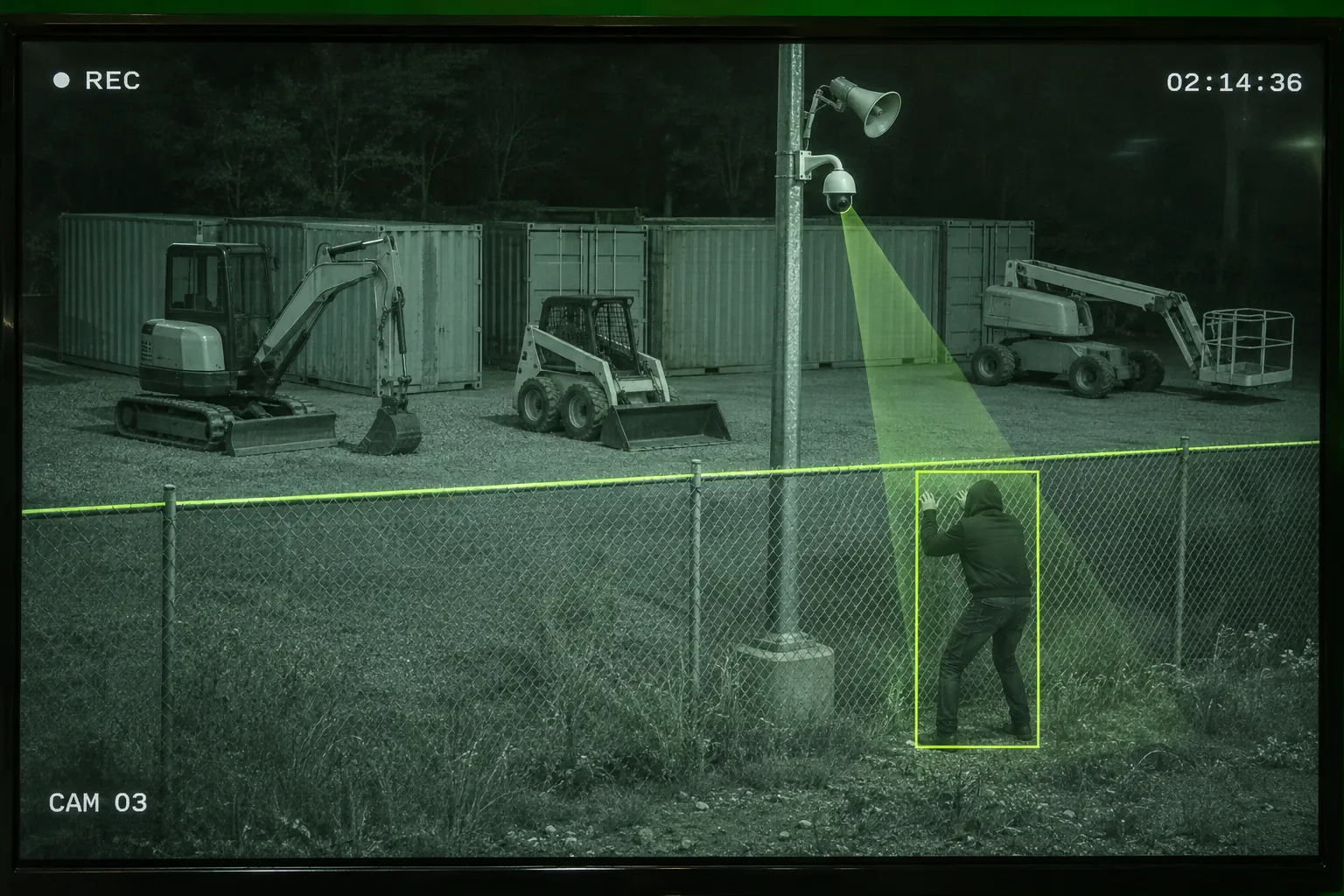
While intruders are on the lot
A potential threat is detected. A trained agent is alerted.
Within seconds, the agent is live on your feed.
Verbal warnings to intruders through two-way audio. An order to leave.
Instant alerts with footage to you.
Authorities notified when required.
Here’s how remote video monitoring works on the cameras you already have.
Our average response time is under 30 seconds, and we count 3,000+ break-ins prevented.
You’re notified as an incident happens, through a reporting group, and we handle the event until the intruder leaves, notifying authorities when required.
From outside Blinkless, on job sites, not yards:
“Police treat it as a burglary in progress not an alarm since someone has already verified that unauthorized people are onsite. We had six arrests with it.”
So the question shifts. Not whether a crew wants your welder, but this: can they be interrupted while they are still on the lot? The 60-day pilot is how you answer it on your own yard.
This time, picture the same morning at the gate. In the night, a potential threat was detected, an agent went live on your feed, ordered intruders off the lot over your speakers, and sent you the alert with footage. You open the gate already knowing what happened on your lot.
Which leaves the doubt that’s about your budget, not their plans: will it fit a yard like yours?
It’s not for a yard like mine. That one sounds like the budget talking.
Fair: round-the-clock guards really can be out of reach. But you aren’t buying a guard’s shift. You’re covering the hours the gate is locked, with remote security monitoring from Blinkless.
- Cameras already up. We can monitor the cameras your yard already has, and typically we only need to install speakers.
- Hours you choose. Nights and weekends, or the hours that fit your yard.
- Several yards, one contract. “Is there even a company that handles this for multiple locations?” That’s an equipment rental owner with four yards. Several yards under one billing address go in one contract.
- A guard you keep. Where a yard already has a guard, the guard can stay and join the reporting group, so they can respond.
- A corner with no power. We support solar camera setups; ask how your site connects.
- False alarms on a big lot. An agent reviews the live feed when activity shows up, so you aren’t the one chasing every alert.
Put that together and the thought changes: I can cover the hours the yard is empty.
What to look at on your own yard, in order
- The gate. What holds it shut, and what a truck could push through.
- The back fence. Where tracks would run, and whether a camera sees that stretch.
- The conex row. The latches, as well as the locks.
- The fuel and battery boxes. What a few minutes there would reach.
- The dark corner. Where your cameras see least.
Then test your cameras the way National Equipment Register’s analyst advised in Rental Management in December 2022: “Cameras should be tested in daylight, twilight and darkness.” Before a holiday, the register’s 2025 Labor Day advice: “Designate someone to check up on job sites and facilities at different times during the holiday.” Bring what you find to your free remote assessment.
- National Equipment Register and NICB, 2016 Equipment Theft Report, (c) 2017 Verisk Crime Analytics, read in a copy posted online, not from its publishers
- David Grant Mossman, National Equipment Register, in Rental Management (American Rental Association), 20 December 2022
- National Equipment Register via Rental Management, 30 August 2024
- National Equipment Register, Labor Day infographic, 2025
- American Rental Association, Rental Management, February 2025
- National Insurance Crime Bureau, news release, 10 May 2023
Quotes from owners, crews and operators are their own words, credited by role. None of them is speaking about Blinkless.
No site visit required
Blinkless runs a free remote assessment from satellite imagery and your existing cameras, with no site visit. You get a written security plan covering what needs monitoring, during which hours, how intruders and break-in attempts would be handled, and who gets alerted. The plan is yours to keep whether you hire Blinkless or not.
- Tell Blinkless where your yard is and what it needs. The machines, the vehicles, the hours it sits empty.
- Blinkless runs the remote assessment. Satellite imagery and your existing cameras, with no site visit.
- You get the written plan. What needs monitoring, during which hours, how intruders and break-in attempts would be handled, who gets alerted.
Start with a 60-day trial pilot, so you can test it on your own yard first.
Trained Blinkless agents watch your cameras live and issue live voice-down warnings to intruders, without stationing a guard on site.
Blinkless’s own figures:
- Under 30 seconds average response time
- 3,000+ break-ins prevented
- Up to 70% lower cost than traditional on-site guards
“As a growing construction company managing multiple job sites, we struggled to find a practical way to keep eyes on everything after hours. Traditional security guards couldn’t be everywhere at once, and the costs were adding up. We turned to Blinkless to bridge that gap, and their remote monitoring system has made a real difference. With full visibility across all sites, we now prevent unauthorized access, vandalism, and material theft.”